IVF with Donor Eggs: A Complete, Honest Guide to What Really Works
Whether your doctor just said the words “donor eggs” for the first time, or you have been quietly researching this path for months — this guide covers everything you actually need to know. No fluff. No scary jargon. Just real information backed by real science.
Let’s be honest. Finding out that you might need donor eggs to have a baby is not news anyone celebrates right away. It can feel like a door closing. But for millions of families, it turned out to be a completely different door opening — one that leads to a healthy baby and, often, a much smoother journey than they expected.
IVF with a Donor Eggs is one of the most effective fertility treatments available today. In fact, it holds the highest live birth rate of any assisted reproductive technology on the market. That is not a marketing claim — it comes directly from data tracked by the Centers for Disease Control and Prevention (CDC) and the Society for Assisted Reproductive Technology (SART).
This guide will walk you through who this treatment is for, how the process actually works, what the real success rates look like, what it costs, and what factors you should know before making any decisions. Let us get into it.
What Is IVF with Donor Eggs, Exactly?
Standard IVF uses your own eggs. Donor egg IVF uses eggs retrieved from another woman — the donor — who is typically younger and has been carefully screened. Those eggs get fertilized in a laboratory with sperm (from a partner or a donor), and the resulting embryo is transferred into the recipient’s uterus.
The recipient carries the pregnancy. She gives birth to the baby. She is the mother — legally, emotionally, and physically in every way that matters during pregnancy. The donor simply provides the genetic starting material.
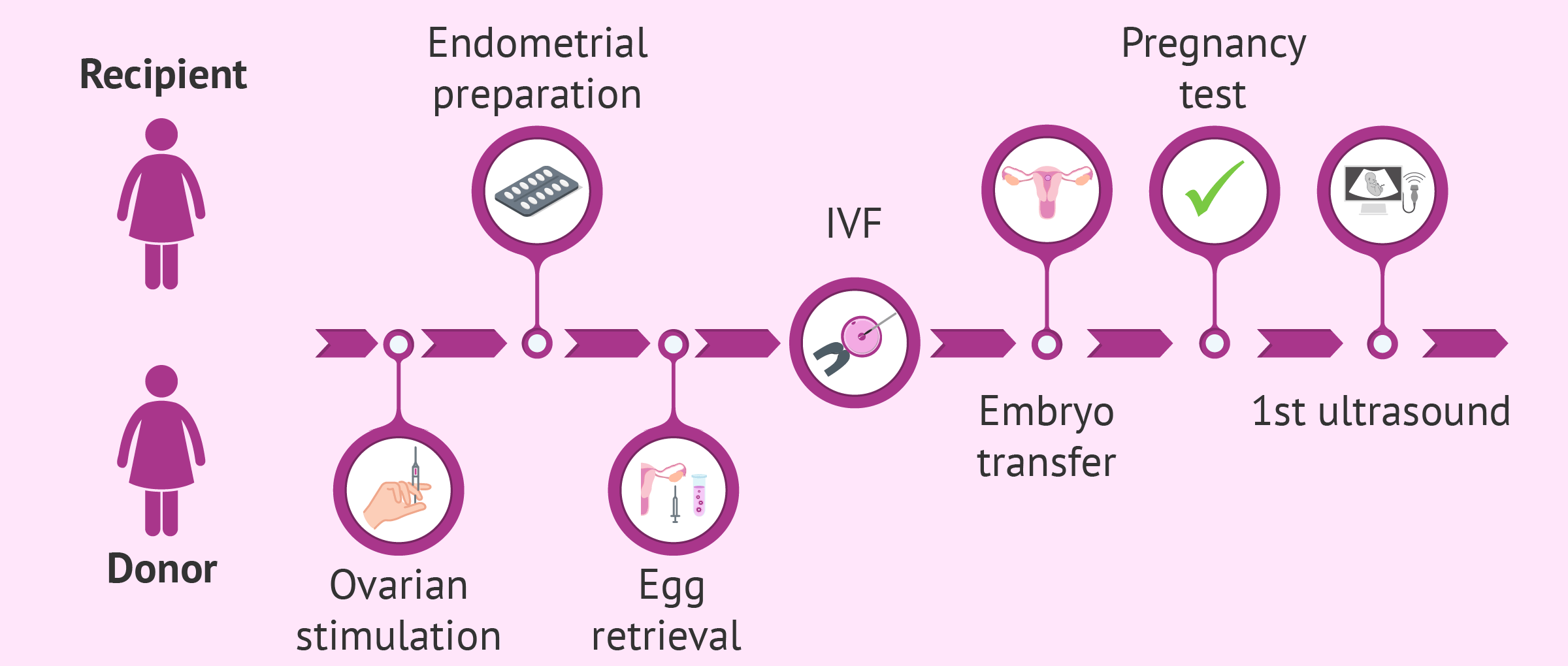
The donor egg IVF process: eggs are retrieved from a screened donor, fertilized in a lab, and the resulting embryo is transferred to the recipient. | Source: Fertility Ireland
According to ASRM’s ReproductiveFacts.org, the first recorded pregnancy from egg donation was reported in 1984. Since then, more than 50,000 live births have been attributed to donated eggs in the United States alone — and the technology has only improved.
Who Actually Needs Donor Eggs?
This is not just for women over 40, though age is one of the most common reasons. The American Society for Reproductive Medicine (ASRM) identifies several clear medical situations where donor eggs become the recommended path:
Medical Indications for Donor Egg IVF (per ASRM Guidelines)
- Premature ovarian insufficiency (POI) or early menopause
- Diminished ovarian reserve — low egg count or poor egg quality
- Advanced reproductive age (typically over 40–42)
- Multiple failed IVF cycles with own eggs
- Carrier of a significant genetic condition that cannot be screened out
- Chemotherapy or radiation that affected ovarian function
- Absence of ovaries (congenital or surgical)
- Same-sex male couples using a gestational carrier
Age matters here more than almost anywhere else in medicine. Women are born with all the eggs they will ever have. As those eggs age, both quantity and quality decline. Chromosomal abnormalities become more common. That is biology — not a personal failure — and donor eggs are a clinically proven way to work around it.
IVF with Donor Eggs: Real Success Rates
Here is where donor egg IVF truly stands apart from nearly every other fertility treatment. Because the eggs come from younger, screened donors, the recipient’s age has a much smaller impact on outcomes than it does with standard IVF.
Compare that to standard IVF: for women over 40 using their own eggs, live birth rates can fall to between 5% and 20% per cycle. With donor eggs, those same women can see rates jump to 45–55% per transfer. That is not a small improvement — that is a complete reversal of odds.
“Donor eggs essentially bypass the age of the birth parent. The success rate is tied to the donor’s age — usually mid-20s — which is why results remain strong even for patients in their late 40s.” — CDC ART National Summary & SART Data, referenced via OVU.com Fertility Insights, 2025
It is also worth noting that fresh donor egg transfers tend to perform slightly better than frozen ones. One dataset showed fresh donor eggs carrying a 41.4% live birth rate, compared to 39.1% for frozen. However, frozen egg banks have improved dramatically since vitrification (flash-freezing) became standard — and in many programs the gap has narrowed considerably.
How the Donor Egg IVF Process Works, Step by Step

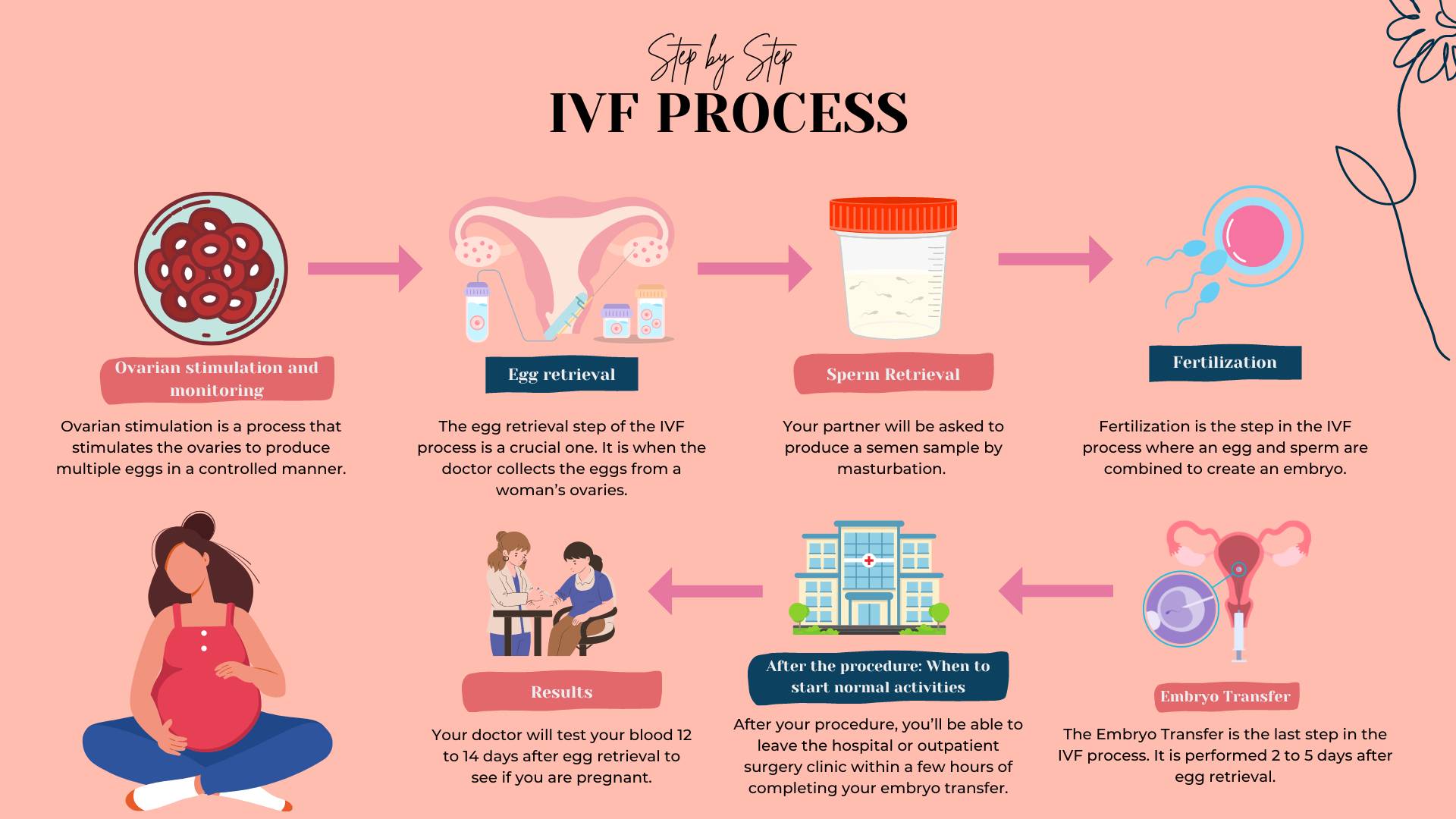
The IVF process from initial consultation through embryo transfer. | Source: Inito
The process involves coordinating two people — the donor and you, the recipient. Here is how it typically unfolds:
- Donor Selection You choose a donor through your clinic’s database or a third-party egg bank. Profiles include medical history, genetic screening results, physical characteristics, and sometimes a personal statement. This step takes time, and that is okay — take it.
- Donor Screening & Medical Workup The donor undergoes extensive medical, genetic, and psychological evaluation. Per FDA and ASRM standards, this includes hormone testing, pelvic ultrasound, genetic carrier screening, and infectious disease panels. This is not a quick process — it typically involves several weeks of appointments.
- Recipient Uterine Preparation You start taking estrogen and progesterone to prepare your uterine lining. This simulates the hormonal environment of a natural cycle and makes your uterus receptive to the incoming embryo. Regular monitoring via blood tests and ultrasound keeps the team informed.
- Donor Ovarian Stimulation & Egg Retrieval The donor takes hormone injections to stimulate her ovaries to produce multiple eggs. About 34–36 hours after a trigger injection, eggs are retrieved using a transvaginal ultrasound-guided needle under mild sedation. The donor typically resumes normal activity within a day or two.
- Fertilization in the Lab Retrieved eggs are fertilized with sperm using either standard IVF or ICSI (intracytoplasmic sperm injection, where a single sperm is injected directly into an egg). Embryos are cultured for 5–6 days until they reach the blastocyst stage.
- Embryo Transfer A catheter places one (sometimes two, depending on your doctor’s recommendation) embryo into your uterus. It is quick, usually painless, and requires no anesthesia. After the transfer, you rest and wait for implantation to occur.
- Pregnancy Test About 10–14 days after transfer, a blood test measures HCG levels. A positive result means implantation has occurred. Follow-up ultrasounds confirm a heartbeat, and at that point, care transfers to your OB.
Egg Donor Screening: What Makes a Donor Eligible?

Egg donors undergo extensive multi-stage screening before they are approved. | Source: Nova Fertility
This is one of the most reassuring parts of the process. Egg donors go through a thorough vetting procedure before a single egg is used. Not everyone who applies becomes a donor — in fact, many agencies and clinics accept only a small percentage of applicants.
According to ASRM guidelines, egg donors should ideally be between 21 and 34 years old. This age window exists for two clear reasons: maturity for informed consent, and optimal egg quality and ovarian response. Donors over 34 can still participate, but recipients must be clearly informed of the slightly increased chromosomal risk.
The screening process includes: a full medical history, pelvic ultrasound and antral follicle count, hormone panels (FSH, AMH), complete genetic carrier screening, infectious disease testing per FDA guidelines (HIV, hepatitis B & C, gonorrhea, chlamydia, and more), and a psychological evaluation by a qualified mental health professional.
ASRM also recommends that any single donor should not donate more than six times in her lifetime. This limit protects her ovarian health and prevents any single donor from contributing to too many offspring in a given population.
How Much Does Donor Egg IVF Cost?
Cost is a genuine obstacle for many families, and pretending otherwise would not be helpful. Donor egg IVF is more expensive than standard IVF, largely because it involves compensating the donor for her time, discomfort, and the medical process she undergoes.
| Cost Component | Typical Range (USD) |
|---|---|
| Donor agency / egg bank fee | $5,000 – $15,000 |
| Donor compensation (fresh cycle) | $5,000 – $10,000 |
| IVF clinical fees (monitoring, retrieval, transfer) | $7,000 – $15,000 |
| Medications (donor + recipient) | $3,000 – $6,000 |
| Genetic testing (PGT-A, optional) | $3,000 – $6,000 |
| Estimated Total (fresh cycle) | $25,000 – $50,000+ |
Frozen donor egg banks can reduce costs significantly, with some programs starting around $15,000–$20,000 for a complete cycle. Multi-cycle packages, financing options, and some employer-sponsored fertility benefits are worth investigating before ruling anything out financially.
Always ask for the clinic’s cost per live birth, not just cost per cycle. A clinic that charges slightly more but has significantly higher success rates can end up being the more economical choice in the long run.
Factors That Affect Your Chances of Success
Donor egg IVF produces the highest success rates of any fertility treatment, but success is never guaranteed. A few key variables still influence outcomes:
Uterine Health
Your uterus is doing the work of implantation and gestation. Conditions like polyps, fibroids, endometriosis, intrauterine adhesions (Asherman’s syndrome), or a septate uterus can interfere with implantation even with a healthy embryo. Your clinic will likely evaluate this before your cycle begins.
Endometrial Thickness
The lining of your uterus needs to be adequately thick and receptive at the time of embryo transfer. Monitoring and adjusting hormone therapy is part of how your team manages this.
Sperm Quality
Even with excellent donor eggs, poor sperm quality can affect fertilization rates and embryo development. A semen analysis before the cycle helps identify whether ICSI or additional interventions are needed.
Embryo Quality & Genetic Testing
Optional preimplantation genetic testing (PGT-A) can screen embryos for chromosomal abnormalities before transfer. Research published in PMC (PubMed Central) suggests that PGT-A can improve implantation rates in donor egg cycles, though it adds cost and is not universally required.
Number of Transfer Attempts
Most families do not succeed on the very first transfer, and that is normal. Cumulative success rates improve significantly with multiple attempts. Most patients achieve pregnancy within three to four cycles of donor egg IVF.
The Emotional Side Nobody Talks About Enough
Science is the easy part to explain. The emotional experience of using donor eggs is something most fertility guides gloss over in about two paragraphs. It deserves more than that.
Many recipients go through a genuine grieving process — mourning the genetic connection they had imagined. That is completely valid. It does not mean donor egg IVF is the wrong choice. It means you are human. Most people report that by the time their baby arrives, the question of genetics fades into the background in a way they did not expect.
ASRM strongly recommends psychological counseling for both the donor and the recipient before, and often during, the process. If your clinic does not offer this, ask for a referral. It makes a measurable difference in outcomes and overall experience.
There is also the question of disclosure — whether to tell your child, and when. This is deeply personal. However, research consistently shows that children who know the truth about their origins tend to do better psychologically than those who find out accidentally later in life. Many families start the conversation early, in age-appropriate ways, and it becomes just part of their story.
How to Choose the Right Fertility Clinic
Not all clinics are equal, and in a field this important, that matters. Here is what to look for and ask:
Questions to Ask Before Choosing a Clinic
- What is your live birth rate for donor egg IVF — per transfer, not per pregnancy?
- How does your data compare to the national SART average for my age group?
- Do you use fresh or frozen donor eggs, and what is your thaw survival rate?
- What is your single embryo transfer policy?
- Is psychological counseling included or available?
- What does your multi-cycle package include and exclude?
You can verify clinic success rates independently using the CDC’s ART Success Rates tool and the SART National Summary database. Both are publicly available and allow you to compare clinics using consistent, standardized definitions — not the numbers a clinic chose to highlight on its own website.
The Bottom Line
IVF with donor eggs is not a last resort. For many people, it is simply the most effective, most direct path to the family they want. It is backed by decades of data, guided by robust medical and ethical standards from the ASRM and FDA, and it has brought nearly 10,000 babies into American families in a single recent year.
Yes, it involves complexity — emotional, logistical, financial. But the science is genuinely on your side in a way that few other fertility treatments can claim. With live birth rates hovering around 50–55% per transfer, donor egg IVF gives many families odds they never thought possible.
If your doctor has recommended this path, the best next step is a thorough consultation — ideally with both your reproductive endocrinologist and a counselor who specializes in third-party reproduction. Ask every question. Understand every number. And make the decision that feels right for your family, with confidence that the medical community has built solid, reliable tools to help you get there.
Sources & References
- Centers for Disease Control and Prevention (CDC). ART National Summary Report. cdc.gov/art
- Society for Assisted Reproductive Technology (SART). National Summary Data. sartcorsonline.com
- American Society for Reproductive Medicine (ASRM). Guidance Regarding Gamete and Embryo Donation (2024). asrm.org
- ASRM ReproductiveFacts.org. Third-Party Reproduction Patient Education Booklet. reproductivefacts.org
- Cofertility. Donor Egg IVF by the Numbers. cofertility.com
- Cofertility. Donor Egg Success Rates: A Breakdown. cofertility.com
- Perkins, J. et al. Differences in pregnancy outcomes in donor egg FET cycles following PGS: a retrospective study. PMC / PubMed Central. pmc.ncbi.nlm.nih.gov
- ASRM. Repetitive Oocyte Donation: A Committee Opinion (2020). asrm.org
- Donor Egg Bank USA. Egg Donation: A Guide to Getting Pregnant with Donated Eggs. donoreggbankusa.com